
Vaping like volcanoes
Staring at strangers at Lily Allen and Hayley Williams gigs
After recently writing about the audience that heckled James Acaster so bad he couldn’t finish the show, I’ve found myself thinking about audiences a lot more.
I’m part of a writing coaching programme at the moment (Hopscotch) held by the incomparable Stevie Mackenzie-Smith. As a life writer and composter of living material, she’s full of excellent questions, prompts, and stories to re-arm your creative practice. A recent prompt from her workshop series “Living Material” (which you should sign up for the next time it runs) was to ask yourself what you keep returning to, the themes, ideas, and images that keep coming up, and act as a correspondent of those ideas.
I’ve had a month full of comedy shows and gigs, because it seems that every artist I love is determined to tour this month. Coming into June, I was worried about how busy I’d be. This month I was meant to be seeing: Dropout Improv, Nick Mohammed, James Acaster, Lily Allen, and Hayley Williams. We missed Nick Mohammed as my partner Chloe was ill. But what struck me was how different each of those audiences were.
I try to channel my inner Kae Tempest:
Even when I’m weak and I’m breaking
I’ll stand weeping at the train station
‘Cause I can see your faces
There is so much peace to be found in people’s faces
Ever since I first heard People’s Faces, I try to settle into it whenever I’m out and about and can manage it. Staring earnestly into the faces of strangers, and trying to feel who they are, why they are. You’re going to bump into a certain amount of projection—although I suppose even that is pretty instructive—but I just find it an activity that actively helps me to build empathy and compassion for my fellow person. To fully witness a person just does something to you.
I’m most partial to that performance of People’s Faces—the cameraman understood the assignment, with close zooms in on everyone’s faces. But I’d be remiss to not point you to this performance, too, where Kae’s own peace radiates so much more heavily now he can more comfortably be himself.
I went to see Lily Allen at the Utilita Arena in Newcastle, a venue I thoroughly despise. I don’t love most arena venues anyway, besides perhaps Glasgow’s Hydro, but the Utilita is something worse. Cheap, hockey-style folding seats. Poor crowd control at the best of times. £9 pints. £7 soft drinks! We’d booked standing because we hate the seats, but Chloe has had a recent back injury so we were sort of cursing ourselves. We managed to find a great spot at the barriers by the tech desks, halfway through the audience. It’s an arena tour—you don’t need to be front and centre to have a good time.
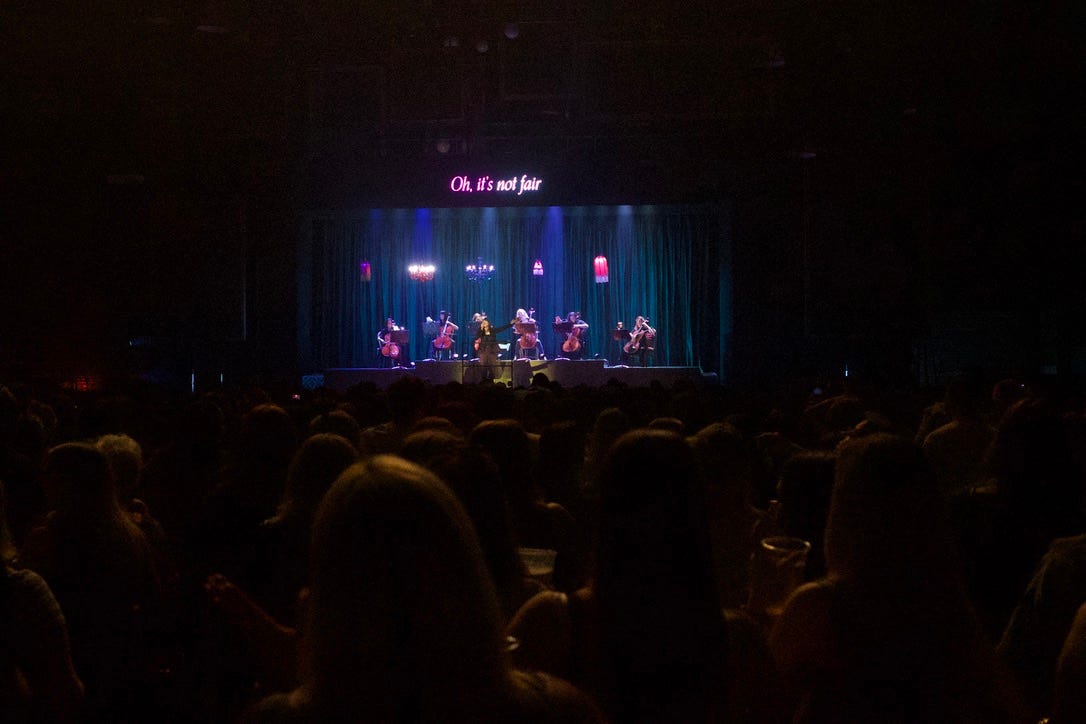
The show starts (2 hours after doors) with 30 minutes of orchestral covers of Lily Allen songs. Whilst this was nice, anything that makes me spend more time in a venue I hate whilst my partner’s pain racks up is not in my good books. Relatedly—why do venues never post their timings anywhere other than inside the venue itself? I get wanting to encourage people to come to support acts. I love support acts. But sometimes you have a bad back, or a babysitter, or something else… and knowing timings—particularly end timings—is important!
The audience at Lily Allen was full of more normal people than I tend to see at most of the more-alternative gigs I go to. I could bump into any number of these people in my office. Maybe there’s some continued commentary on mainstreamness to be had here, I don’t know. All the same, it was nice to see normal people being normal. My friend Eve remarked on it, even—here were just people that looked like people, not Instagram-aestheticised versions of people.
When the gig started proper, I started to struggle with my fellow audiencemates. Remember, People’s Faces. I really try to find people charming at gigs, but sometimes it just escapes me.
Behind me, there was a group of exceptionally loud gay men. They provided a running commentary to the entire gig. And look—I’m halfway back, it’s a Tuesday, I actually don’t even mind that. But sometimes it just felt the tone was a little off—like the parasocial thread was being pulled strongly. Throughout the gig, Allen doesn’t interact with the audience. It’s a one-woman play set to music, if anything. Yet these guys seemed to earnestly feel they were in conversation with her. Look I’m finding a lot of words to say they kept barging me and I was annoyed by that, but that.
They were doing poppers on and off throughout the gig, which like—really? It’s a Lily Allen gig on a Tuesday and it’s 9pm?—and calling her mother, and other such plaudits. Someone smarter than me will have written a thinkpiece on the tendency of gay men specifically to identify with high-glam female musicians and call them mother (is it an appropriation of ballroom culture? it feels like an appropriation of ballroom culture), so I’m not touching that. I’m just saying when it’s in your ear, it’s annoying.
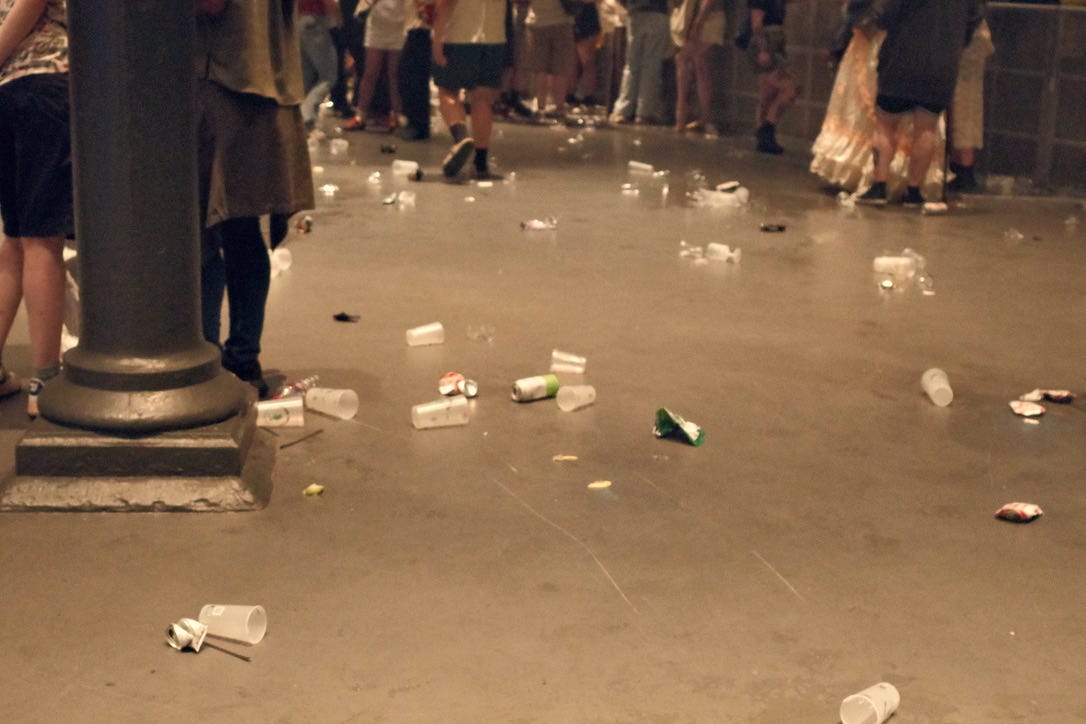
The worst part, though, was the vaping. There’s a moment just before Relapse where Allen reaches into the fridge on stage, pulls out a vape, and gives it a pull. The audience found it iconic. It was funny, sure, but I struggled to laugh because I knew what would happen next. The crowd erupted like so many volcanic craters venting steam. All across the audience, people vaped into the air, a bizarre sign of solidarity. I wish I could have caught a photo of it, with the ‘no vaping’ sign in the background.
I don’t specifically have a problem with people vaping inside because I don’t know enough about the impacts of secondhand vape, if there are any. What I do know is it is worsening a generation’s addiction and it’s really gross to clean a venue that’s had that much vaping in it. Vapes are mostly propylene glycol, which leaves a sticky residue. When it’s just you doing it it’s going to take ages to build up. When an entire audience does it—ew. I think this is part of the livingroom-itis one commenter mentioned in my Acaster post—people treating it as if they are the only people having an experience at a given gig.
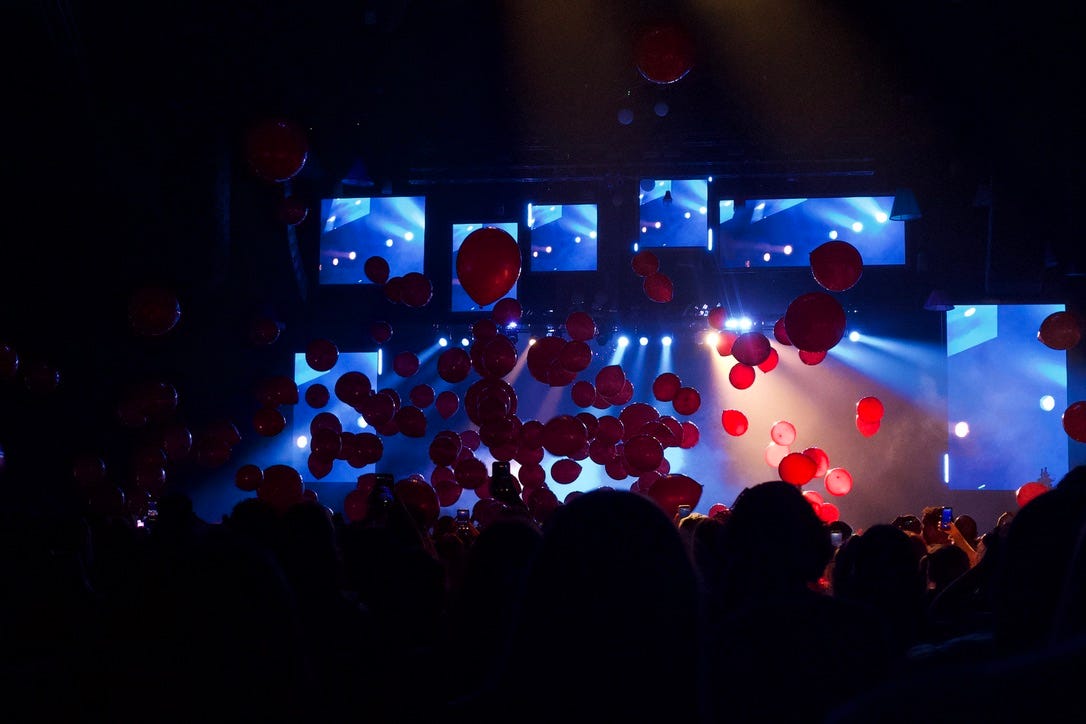
We all played keep the balloon in the air together though and that was nice.
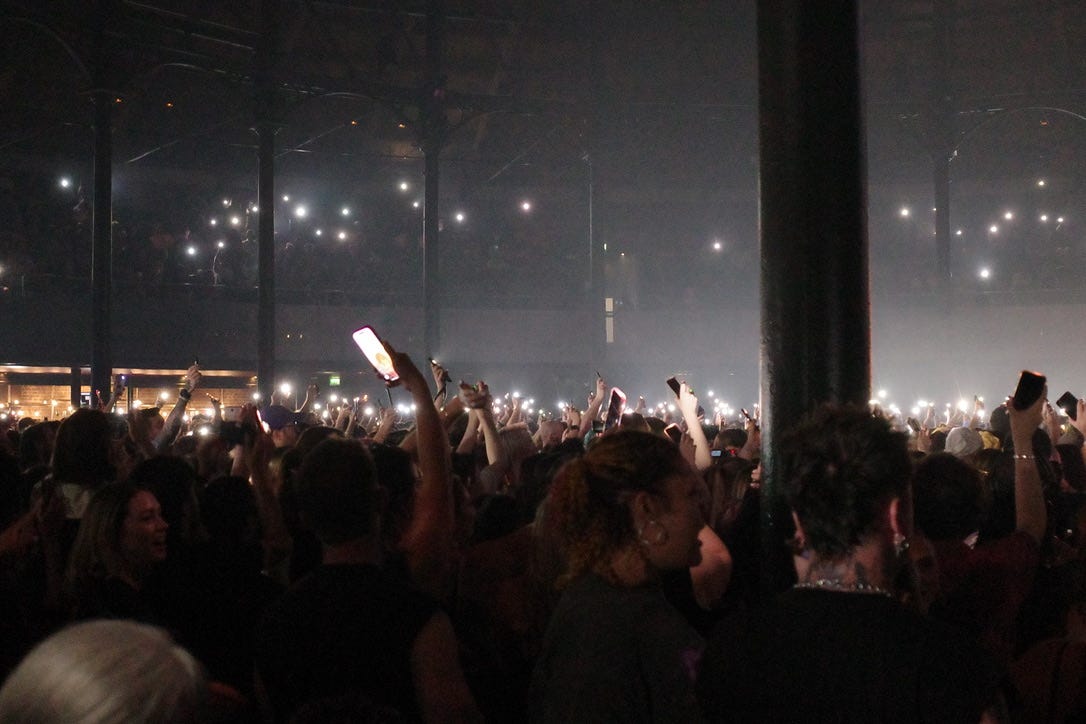
The audience at Hayley Williams gig at the Roundhouse in London couldn’t have been more different. There’s definitely a size thing here, of course—the Utilita’s capacity is 11,000 to the Roundhouse’s 5,000. There’s also the fact that Hayley Williams and Paramore have definitely cultivated a kinder sort of audience over the years specifically.
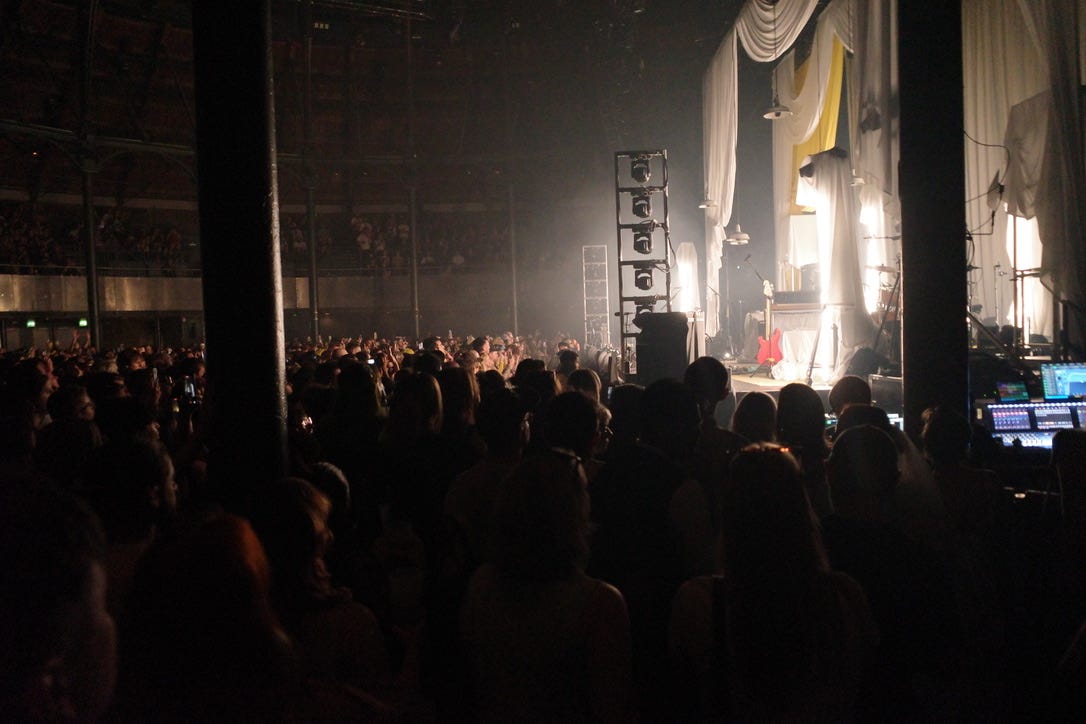
This gig was great. It was great because I love Hayley’s music, but it was also great because everyone was having so much fun. People dancing with strangers, people getting out of the way to let teenagers whose first gig it seemed to be get a better view. I had room to move. People sat on the floor at the back!
I found myself becoming obsessed with this audience, for our sheer togetherness and joy. Sometimes I think there’s just this joie de vivre or collective effervescence, and sometimes there isn’t. And it’s about ourselves, too—I wasn’t feeling it at Lily Allen but I’m sure some people were.
As I became obsessed with the audience I found myself wanting to photograph them more than Hayley. To capture people in the throes of having an amazing time set to music they love and brilliant lighting.
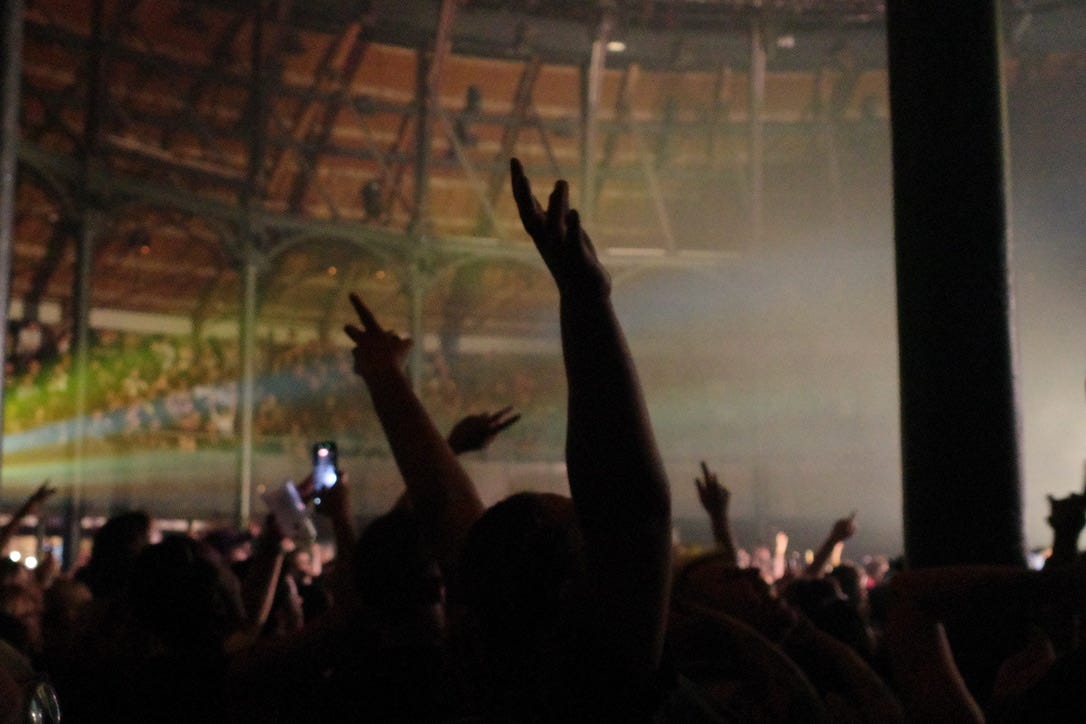
It made me, audience correspondent, think about how to tell the stories of these people. How much I might learn by watching people having the best time. How it must feel for artists to be on stage and look out at all of those fans, what a strange experience of self and collectivity it must give them. How connecting that must feel to the human fabric—and how dangerous living room-itis would be, how worrying to think of a show as an experience for us as individuals and not for us as a collective.
I think about how much better my writing would get if instead of trying to think people up I just instead paid attention to the people around me. What were each of them doing today, before this? What does it mean to them? Which was their favourite song? Have they been to the Roundhouse before? Have they danced here with someone they love? Have they lost them?
You feel people coming together, coming apart, coming together again. If my friend Dean ever starts a Substack he’d write about this so much more eloquently than me, as he’s a festival afficionado. So full of the love for collective effervescence that he spends whole months of every year chasing it, being committed to that kind of collectivity and joy, however fleeting.
When I was at Lily Allen I was thinking that I would be writing about phones at gigs and how they change the experience—noticing so many people on their phones throughout, and having just booked Phoebe Bridgers tickets this week, where there will be no phones allowed. I’m interested to remember what that’s like again. But that’s a story for another time, because the audience correspondent hasn’t witnessed it yet, so there’s not enough to report on from the frontlines of audiences.
And hey, no audience is perfect.
GOD DAMN I FORGOT TO ADD SOME LOVELY GUY GAVE ME FREE SHINY POKÉMON CARDS WHICH I DON’T COLLECT ANY MORE BUT IT WAS STILL A LOVELY GESTURE
Your gig experiences and reflections are really thought-provoking and interesting to read! "Collective effervescence" hits on what I hope for and enjoy most at shows. I reckon it's a weird alchemy that depends on so many factors: the artist and their nature; the nature of the fanbase; the venue and location; even the time of year.
I feel that, as I've got older (and less antisocial), what I want most out of gigs is to feel I'm part of a shared human experience, participating in something that we're all enjoying as one regardless of all our individual differences. Something that transcends mundane life and the private enjoyment we have of the music at home thanks to modern tech. But that can't happen if people approach concerts with main character energy and an individualist mindset.
Two things I can compare from gigs I went to last year: at a smallish metal gig, I saw one guy turn his back to the stage and faff around shooting a selfie video of himself singing along to a song. In doing this he was missing the actual musicians he'd paid to see playing that song behind him while also bothering other giggoers who had to clear space for his private video. Then there was a massive punk gig with an entire hall of people bouncing up and down in unison, a sea of people all moving as one and one with the band and their music.
That was collective effervescence. It's a euphoric feeling that still thrills me months later. It also highlights just how narcissistic and idiotic metal concert karaoke bloke was. Anyroad, that's a long digression for a comment and I'll leave it there with "Really good writing and, yes, observing gig audiences is a fascinating endeavour".